

February 13, 1924 (page 13 of 22). (1924, Feb 13). The Gazette Times (1905-1926).
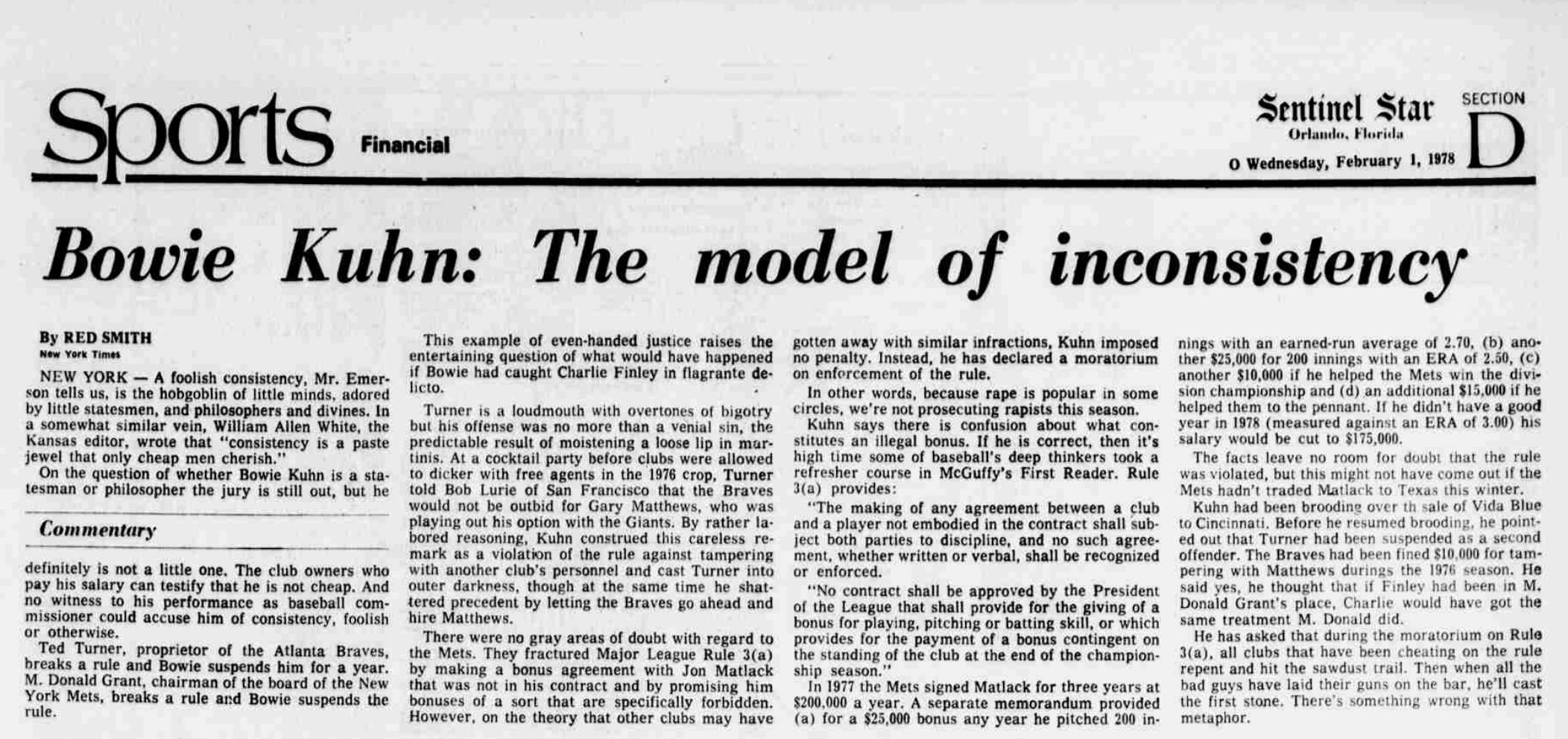
February 1, 1978 (page 30 of 249). (1978, Feb 01). Sentinel Star (1973-1982).

History of Contract Incentives
The history of incentives in MLB contracts is a somewhat unexplored area relative to other historical aspects of the business of baseball, but it provides important context for the current rules and incentive system. This brief history of incentives in MLB contracts illustrates two main points. First, the rules regarding impermissible bonuses have remained remarkably unchanged over the last century. Second, there has been a consistent, but not overwhelming, tension between teams and the league regarding attempts to circumvent the prohibitions.
1920’s: The Beginning of the Incentive System
The current regime appears to have started In 1924, when the National League reportedly approved a new rule banning performance bonuses based on a “playing, pitching or batting skill”. Since its inception, the predominant reasoning for banning these forms of bonuses has been that a team has the ability to determine whether a player reaches a bonus in a contract, for example by sitting a player once they neared a particular landmark that would award them a bonus.
Research of player contracts from around this time by Michael Haupert found that bonus clauses were uncommon, with less than four percent of surveyed player contracts having bonus clauses in 1924, and just over 11 percent in 1934 and 1944.
1970’s: Incentives Under Fire
The 1970’s marked a significant period of focus on bonuses in contract. Then Commissioner Bowie Kuhn, who was Commissioner from 1969 to 1984, appeared to have a particular interest in how bonuses were being used, leading to an increase in enforcement action regarding these clauses. As an early indication of his focus on bonuses, Kuhn fined the Cleveland Indians in 1971 for violating the bonus rules in player contracts. However, the issue came to a head starting in 1976, when the New York Mets sought the Commissioner’s approval for a contract with Tom Seaver with an unusual bonus structure. The Seaver contract contained a clause that would pay Seaver an additional $5,000 for each start he would be scheduled to make, regardless of whether Seaver actually made this start, after Seaver reached 19 wins on the season. While the contract was ultimately approved by the Commissioner, coverage of the contract at the time showed tensions regarding the bonus rules. For example, in June 1976 article by the Associated Press, Mets General Manager Joe McDonald was quoted as saying that the league had initially taken the view that the bonus clause violated the prohibition on skill-based bonuses, and that McDonald’s view as follows:
“I think we're out of that era. and if a player doesn't think the general manager will honor it, he shouldn't enter into a performance contract. but if a player wants and I want it and he trusts me, what's wrong with that."
MLB owners were considering amending the bonus rules around this same time. A 1978 article by Red Smith reported that the owners had approved a rule allowing for new forms of bonuses in August 1976, but that it had subsequently been suspended by their Executive Council and then ultimately rejected at the Winter Meetings in December 1976.
2000’s: Incentives and ‘Marketing Agreements’
The next main wave of attention on the bonus rules came in the late 2000’s/early 2010’s, when notable players obtained bonus structures in marketing agreements that were separate from their player contracts. These marketing agreements were seemingly structured to circumvent the prohibition on bonuses based on batting skills in player contracts. The two main focal points for this issue were the 2007 contract between Alex Rodriguez and the New York Yankees, and the 2011 contract between Albert Pujols and the Los Angeles Angels. Rodriguez’ marketing agreement provided that he could receive $6 million each time he achieved a historical milestone as designated by the Yankees. These milestones were reportedly surpassing the career home run totals of Willie Mays, Babe Ruth, Hank Aaron, and Barry Bonds. This agreement resulted in a legal dispute, eventually resolved in 2015, when the Yankees refused to pay Rodriguez a bonus contemplated under this agreement, on the basis that these provisions were discretionary and that the Yankees had the right, but not the obligation, to make these payments. The Pujols marketing agreement provided that he would receive $3 million if he reached 3,000 hits, and $7 million if he surpassed the career home run total of Barry Bonds.
In March 2012, the MLBPA and MLB agreed to ban these types of marketing agreements moving forward, on the basis that they were prohibited by the bonus rules outlawing bonuses for hitting and playing skills.
The issue reappeared in 1978, when Mets pitcher Jon Matlack was traded to the Texas Rangers. In connection with the trade, the Rangers learned that the Mets had signed an agreement with Matlack outside of his approved contract, which provided Matlack with bonuses based on, amongst other things, Matlack’s ERA and whether the Mets won a Pennant or the Division Championship. The Rangers brought this agreement to the Commissioner on the basis that it was an impermissible form of bonus. As reported in Red Smith’s 1978 article, Kuhn’s response was to impose a temporary moratorium on enforcement of the rules regarding impermissible bonuses during which all teams with impressible bonus agreements were expected to come forward and disclose any unapproved agreements that they had entered into. Kuhn’s reported reasoning was that, in his view, these undisclosed side agreements were very common and that there was confusion in the league regarding what constituted an impermissible bonus.